dailygolf gets a new course every day and new features most weeks. This page lists every change worth knowing about, newest first. A change to how courses are built never touches a day that has already started, so the course you’re playing never shifts under you.
A quicker walk to the next tee
We’re trying a shorter scorecard with some first-time Daily players. You keep the same version when you come back for another Daily during the test. The shorter card shows how many holes you’ve finished, then takes you to the next tee after three seconds. Choose Stay here to read the full scorecard or Next hole now to go straight on.
Nine new daily challenges, four new settings and six new Classics
Starting Saturday, November 21, there’s a lot more to the day. Every course and challenge before then stays exactly as it was.
Nine new daily challenges join the five there were, so it takes two weeks for one to come back. Four are arcade games: Top corner puts a soccer goal on the fairway (aim for the top corners), Buckets has three giant basketball hoops to drop the ball through (off the backboard counts), Pool is a pool table on the green with cushions and six pockets (bank shots score double), and Tic-tac-toe paints a board on the green where each ball claims a square and three in a row wins big. The other five test the rest of your game: a Long putt from across the green, a Sand save from a greenside bunker, a Chip-in with rings round the hole, Down the middle (the drive nearest a line painted down the fairway) and On the number (finish as near as you can to a line painted the day’s distance from the tee). How to play has the rules for each.
Four new settings for the days a course is set somewhere other than the parkland: Volcanic, with black-sand bunkers and lava rock and a volcano on the skyline; Lakeland, where there’s water round every corner; Prairie, flat, golden and windy, with windmills and barns; and Savanna, with flat-topped acacias in the long grass. Each has its own patch of ground to watch out for: cinders, shingle, stubble or red dust.
New set pieces on generated holes: greens sunk in a punchbowl that feeds the ball in, two-tier greens, Biarritz greens with a dip through the middle, a cross bunker right across some par 5s, and rows of church-pew bunkers beside the fairway.
Six new Classics, tributes to famous holes: Augusta’s Redbud, Cypress Point’s 16th over the Pacific, Royal Troon’s Postage Stamp, Oakmont’s Church Pews, and Carnoustie’s Hogan’s Alley and closing hole. The new par 3s also turn up on challenge days. See the Classics.
A smaller points summary after your round
Your round results now show points earned and your total in a compact row below the standings or scorecard. Progress toward your next reward appears underneath, with a shortcut to view it in the shop.
Chat in games with friends
Everyone in a game with friends can now send messages. On the course, and while you watch the others, chat starts minimized to a small bubble: on the right on a computer (press Enter to type), or at the top under the hole’s name on a phone. Tap the bubble or press Enter to open chat; the minus button minimizes it again. A dot on the bubble marks unread messages. Chat is hidden in the waiting room, between holes, and on the final results screen. Messages show the player’s name, scores and arrivals appear separately as brief notices, and the smiley button has quick messages like Nice shot! and GG that send with one tap. Words that would offend are starred out, the same as in names, and the chat is deleted with the game.
Advanced shots when you’re ready
Low and high shots are now an optional control setting. Turn them on anytime under Advanced shots in the game menu, or from How to play. After five completed Daily, Unlimited or friends rounds, a one-time invitation offers Enable or Later. Your controls never change automatically.
Hosts can also choose Club bonuses under Game rules. They start off in new friends rooms and lock at tee off. With bonuses off, your skins keep their look and every club uses its standard distance. Daily courses and challenges always use the same bag.
Low shots, high shots and better clubs
Pull back down and to the left for a low shot, or down and to the right for a high one, then flick back up the way you pulled. The woods hit a stinger or a high launch, the hybrid and irons a punch or a high soft shot, and the wedges a bump and run or a flop. Low shots stay under the wind and run out. High ones clear trees and stop quickly. Pulling straight down plays the normal shot, as before.
The driver now stays in the bag after the tee shot. From the fairway and everywhere else, the longest club is the 3 wood.
In Unlimited and games with friends, club sets add distance: the driver gains 5 yards with Blackout and up to 30 with Gold, and every other club the same share of its carry. The daily course and the daily challenge stay the same for everyone.
Bunkers are a little kinder
Bunker shots come out fat or thin less often: the sand wedge about one time in twelve (it was one in eight), a 7 iron one in four and a 3 wood about half the time. A fat one also goes a little further. A clean strike plays as before, and so do the bunkers themselves.
A clearer view from the bunker
Spectating finds a clear angle around steep banks and nearby trees, keeping the golfer at a natural size instead of zooming too close or looking down from far above.
After learning to swing and aim, beginners get a short tip about matching the landing ring to their target, followed by a wedge tip near the green. Club arrows at the ends of the bag stay dimmed and never receive the tutorial highlight.
A lighter grip for trackpads
Hold Space instead of pressing your trackpad or mouse button, then pull down and flick up to swing. Your movement sets power, direction and curve just as before. Release Space early to cancel. Space still speeds up flyovers and ball flight.
Keep your score when you rejoin friends
Leave and return to the same round and your completed scores, current ball and used mulligans come back with you. If the group has moved on, unfinished holes count as picked up. Your round stays saved until a new round starts or the room expires.
Your look, the same game
All outfits, balls and club sets are now cosmetic in every mode. Your skins and flight trails stay yours, and every set uses the same shot physics. Equipment bonuses have been removed from Unlimited and games with friends.
Hosts can choose one mulligan per round or none in Game rules. The setting locks at tee off.
Update, October 14: Club sets add distance again in Unlimited and games with friends. Outfits and balls stay cosmetic.
Less waiting between holes
The next hole gets ready while you play, reducing the wait at the next tee. Courses keep the same detail, layout and physics.
Spectator arrows sit beside the player’s name, and the player counter uses the matching font. Home now says “Heading home” while loading. Skipping a flyover ramps up to a steady faster pace before settling at your golfer.
Keeping up with the player you’re watching
When a player is ready to aim again, spectators follow their current ball instead of continuing an old shot. Drops and mulligans reframe the camera immediately. Moving to another hole also clears the pause from a dismissed menu, so the flyover and controls can continue.
Clearer scores and a better view
Three-hole rounds use the compact stacked scorecard again, while nine-hole rounds keep the wider desktop layout. Phone results have more space around the heading and each player’s scores, and Play again is a regular-sized button.
Spectating frames your selected player immediately and moves the camera in front of obstructing trees and hillsides. When everyone’s final shot has played out, the results open automatically.
More room for your round
Between holes, your scorecard and the multiplayer leaderboard sit side by side on desktop. On phones, switch between them with the My scorecard and Leaderboard tabs. The buttons to watch, move on, or leave stay in view while the details scroll. Final results have the same fixed actions, with all nine hole scores on each player’s row on wider screens.
Choose who to watch
When you finish a hole before your friends, use the arrows beside their name to choose who to watch. The camera stays with that player until they finish or leave, and the keyboard’s left and right arrows switch players too. Disconnected golfers and leftover shots no longer linger on the course while you watch.
How to play, one step at a time
The in-game guide now has three short pages: aim, swing and putt. Back, Next and Got it stay visible at the bottom, even on a small screen. Tap a step to jump to it, or expand the extra tips when you need them.
Friends
Add your friends. With an account, press Friends on the title screen for your friend code and a link to send. Once a friend adds you, you’re on each other’s lists.
See how they did. Your friends are listed with their score on today’s course and their best in the daily challenge, and your result screen shows them beside you.
Play together. See who’s online and what they’re playing. From a game with friends, invite them with one tap. They see it on the title screen, between holes or on their result, never in the middle of a shot. If a friend is already in a game, you can join it from your list.
New challenges, odd ground and a top ten
A top ten on the daily course. When you finish, the result screen lists the day’s best ten by name and flag, and where you stand if you’re further down. You’re on it under the name you use in the challenge and games with friends, and you can change it right there.
Five daily challenges. From Friday, October 9, the challenge changes every day, and it’s set in the same place as the day’s course. Bullseye paints a dartboard round the pin, and each ball scores the ring it lands in. Target range has three targets down the hole, and the further ones are worth more. Through the hoop floats a ring short of the green, with bonus points for finishing on the green or in the hole. Long drive counts your longest drive that stays on the fairway. Closest to the pin still comes round too.
Ground of its own. About one hole in ten now has a patch of its setting’s own ground where shots come down: ice in a winter wood, a snow drift in the Alps, hardpan in the desert, baked ground on a links, a leaf pile in the autumn, a puddle in the tropics, a bog on the heath, a soggy spot in a parkland or a drift of petals under the cherry trees. Each plays its own way, from skidding on to stopping dead. Unlimited and games with friends have them now, and the daily course from Friday, October 9.
New places to play
Every course now has a setting of its own, and all its holes share it. Thursday, October 8 is on a links. From Friday, October 9, most days are in the parkland and about one day in three is somewhere else, never two days running, and each setting takes its turn before any comes back. Unlimited courses and games with friends get them now, about one course in three.
Parkland. Green and wooded, as before.
Links. Humps and hollows by the sea, golden fescue, gorse and pot bunkers, hardly a tree, and more wind.
Desert. Green fairways through the desert floor, saguaros, oasis ponds and red rock rising in terraces. Some days end at dusk.
Autumn. Maples, oaks and birches in red, orange and gold, with leaves on the ground and in the air.
Alpine. A valley under snowy peaks: spruce forest, granite boulders, glacier lakes and big drops from the tee.
Tropical. Palms, lagoons, white sand and more island greens.
Winter. Snow beyond the rough, frosted trees and falling snow.
Cherry blossom. Pink cherries, red maples, koi ponds, petals on the breeze and a snowy volcano on the skyline.
Heathland. Purple heather, birch, pine and gorse, with sandy waste areas.
Each setting changes how the holes are built, not just their colors. A links has few trees and more wind, a desert has less water and more rocks and waste areas, and the tropics have more water. The trees, the hole names, the sky and the light change too. The title screen names the course and its setting. Off the fairway, the deep stuff is called by what it is: fescue, desert, snow or heather. It plays the same as deep rough.
Clubs and balls that play the part
Update, October 13: These equipment bonuses have been removed. All skins are now cosmetic in every mode.
Clubs and balls do more than look good now. In Unlimited and games with friends, the clubs and ball you have in play change how your shots fly. The daily course stays the same for everyone: there, every bag plays like the Classic.
Clubs. The more a set costs, the further the driver carries, from 4 more yards with Blackout to 25 more with Gold, and the more the wedges spin. The extra spin counts most on short wedges, and on the green the ball pulls back further. Clubs cost more to match: Blackout is 500 points and Gold 15,000.
Hi-Vis. The aim shows where the shot comes to rest as well as where it lands.
Range. An overswing curves 20% less.
Bubblegum. Sticky: it runs out less when it lands.
Eight Ball. Putts drop more easily.
Smiley. Lucky: it keeps more of its speed through the leaves.
Fireball. The wind moves it 25% less.
Gold. A low, fast shot skips once off water, and it has a little of the Range, Eight Ball and Fireball too.
The Skins screen says what each set of clubs and each ball does. Clubs you already own stay yours.
Don’t crawl through the ball
How fast you flick still doesn’t matter, unless it’s slow. A swing that pushes slowly up through the ball instead of flicking it, taking more than about a third of a second to come up, hits it weakly and comes up short, by as much as 40% at a full second. You’ll see Too slow! when it happens. Any normal flick, even a careful one, hits it full. Putts aren’t affected.
Daily challenges, starting with closest to the pin
Every day now has a challenge as well as a course, the same for everyone, with a leaderboard of its own. The first kind is closest to the pin: three balls from the tee of a par 3, and the one that stops nearest the hole counts. Press Daily challenge on the title screen. Each ball counts the moment you hit it, the next one starts with the same club and aim, and the earlier ones stay where they stopped so you can see what to change. A ball in the water or out of bounds has no distance, and a hole in one wins outright.
The leaderboard shows the ten closest balls of the day with each player’s name and country flag, and where you stand if you’re further down. Your name is the one you use in games with friends; until you pick one you’re “Golfer” and a number. About one day in four the challenge is on one of the Classics’ par 3s: Golden Bell at Augusta, the island green at Sawgrass or Pebble Beach’s little seventh.
Accounts, real bunkers and the lie of the land
Accounts. Press Keep your progress on the title screen to make one with your email address and a name. Your points, skins, stats and Unlimited are saved to it as you play, so they come with you to every device you sign in on and come back if your browser is cleared. There’s no password: each time you sign in, we email you a code. Accounts are optional, and the game works just as before without one.
The ground shows its shape. Slopes, hollows and ridges are now shaded so you can see them, and high ground looks lighter than low ground. Greens show their contours too: the high side is lighter and the low side darker, so you can see which way a putt will break even with the slope arrows off.
Names in games with friends. Words in names that would offend are now starred out, however they’re spelled.
The Classics on the daily course. As announced, about one daily course in three now swaps a hole for one of the Classics.
The whole flick counts. Where your swing finishes still sets the line the ball starts on, but now a flick that wanders on the way up curves the ball the way it wandered, even if it comes back to finish straight. The trace only says Straight when the flick stayed straight all the way. The strategy guide has the details.
Bunkers play like bunkers. The ball has to climb over the face to get out, and a shot that can’t buries itself in it. Out of sand the sand wedge now gets 75% of its carry (it was 90%), hybrids 45% and woods 30%. Any bunker shot can come out fat or thin, the long clubs most often. Waste areas play as before.
Coming Wednesday: drivable par 4s
From Wednesday, October 7, about three par 4s in ten are short enough to drive: 210 to 300 yards, sized to the day’s wind. They’re built to make you pay for trying. The green is an island, a peninsula with water on three sides, or a raised fortress ringed with deep bunkers, and the wind always blows 10 to 25 mph. Greenside bunkers everywhere get deeper from the same day, with a steep face toward the green, so only the sand wedge gets out reliably. Unlimited courses and games with friends have them already.
Two ways to the green
On most par 4s and par 5s the fairway now forks and joins up again further on. It splits around a stand of woods, a chain of ponds, a ridge, a waste area, or a bank between a high road and a low one. The route on the inside of the bend is often 30 to 60 yards shorter, but it’s narrower and closer to trouble. The other route is wider, and any water near the green tends to sit on its side. Some par 3s get a bail-out area that skirts the water in front of the green. The starting aim follows the safer route, or the one your ball is on. The strategy guide has more on choosing between them.
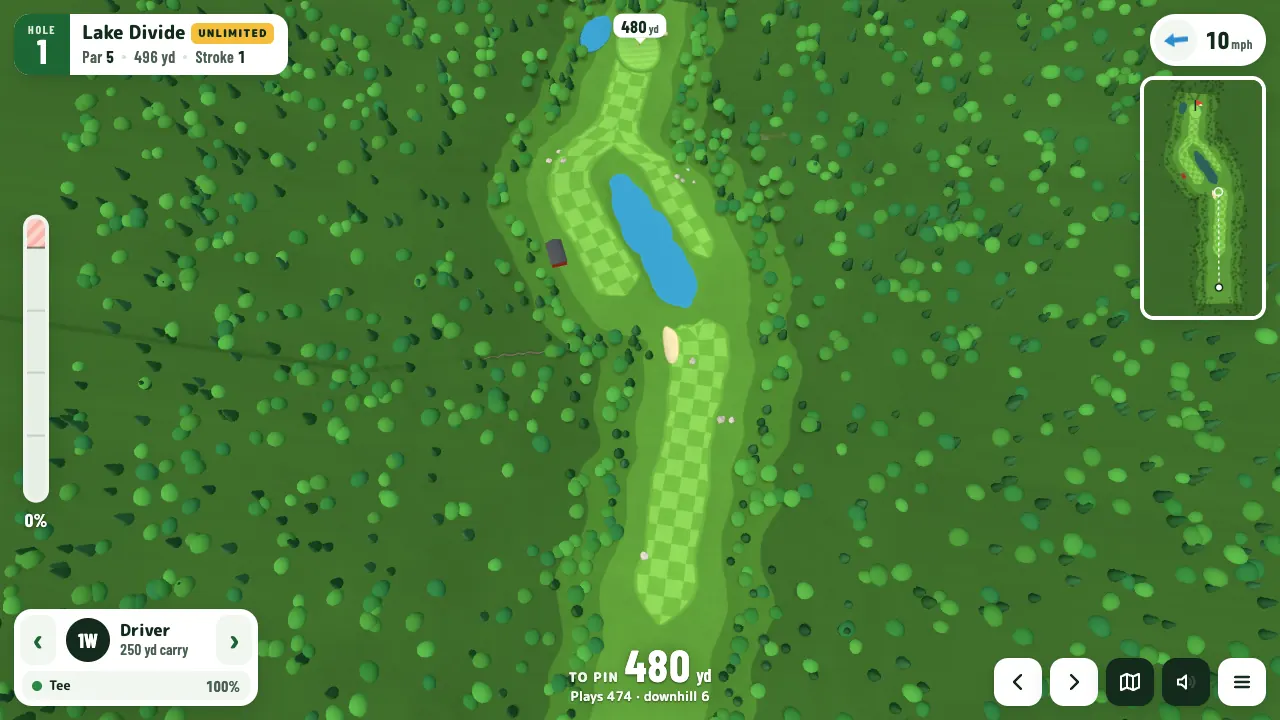
A par 5 from above (press V), with the fairway split by a lake into a left route and a right route.
Coming tomorrow: the Classics on the daily course
From Monday, October 5, about one daily course in three swaps a hole for one of the Classics, famous holes rebuilt by hand: Amen Corner at Augusta National, the finish at TPC Sawgrass with its island green, Pebble Beach above the Pacific, and the Old Course at St Andrews. They take turns, so you’ll see all twelve before any of them comes round again. The course is still a par 3, a par 4 and a par 5.
Skins. Holes under par earn points: 10 for a birdie, 30 for an eagle and 60 for an albatross, plus extra for a chip-in, a hole-out from further away, or a hole in one. Spend them on outfits for your golfer, balls with their own flight trails, and sets of clubs, from Blackout and Hickory to Gold. Press Skins on the title screen to look around the shop.
Half the wind. The wind now pushes the ball half as hard as before for the speed shown. At 10 mph a 7 iron loses about 11 yards into it and drifts about 9 across it.
One mulligan per course. Everyone gets the same single do-over on every course, daily, Unlimited or with friends. It takes back the shot and any penalty.
New hole shapes. From this day’s course on: sharp doglegs, S-bends, sweeping curves, fairways split by a river, ponds in the corners of doglegs and lakes to carry between islands of fairway.
Clubs in detail. Each club now has a proper head, with grooves on the irons and wedges.
Play with friends
Games with friends. Up to 10 people can play the same course at the same time, each on their own device. You see everyone’s golfer line up, swing and hit, with a live leaderboard and a line of news about who just made what. Play three holes or nine, on a new course or today’s, and invite people with a link or a five-character code.
Unlimited. A new random course whenever you want one, with stats of its own.
Overswing. Pulling the meter past 100% now costs you: the ball hooks, cuts or slices at random, and usually comes up short.
The Classics. Famous holes rebuilt by hand arrived in games with friends as whole courses, and by the evening as single holes mixed in with the generated ones, in Unlimited too.
The first daily course: a par 3, a par 4 and a par 5, the same for everyone in the world, with a new one every day at midnight Eastern time. Launch day also brought:
A full bag of clubs, with ball flight that responds to spin, wind and the slope you’re standing on.
Greens with a grid of slope arrows for reading putts, and a switch to hide them.
Instant replays of chip-ins, hole-outs and long putts.
A shareable result with every shot, plus streaks, stats and a daily leaderboard.